Return to sport after arthroscopic rotator cuff repair: epidemiology and prognostic factors in a Swiss multi-centre cohort
Keywords: return to sport; rotator cuff repair; shoulder surgery outcome
Why is this study important?
Return to sport (RTS) is a key expectation for physically active patients undergoing arthroscopic rotator cuff repair (ARCR) (1).
Previous studies analysing the outcome of RTS have focused on a narrow subgroup of patients (2-5) and only limited epidemiological data and sports activity levels in a large population of patients with rotator cuff tear (RCT) have been described to date.
Our study aimed, first, to describe sports activity levels and epidemiological data of patients undergoing surgical treatment for partial-thickness or full-thickness RCT; and second, to determine their return-to-sport rates and to investigate prognostic factors for full RTS (6). Understanding these factors is clinically relevant, as it supports the development of tailored rehabilitation strategies that incorporate psychological, activity and injury-related factors to optimise RTS outcomes.
How did the study go about this?
Inthis analysis, we included 725 patients who participated in sport before their injury and were available for follow-up.
Injury characteristics, sports activity, sociodemographic, psychological and rehabilitation-specific factors were recorded preoperatively and postoperatively at 6 weeks, 6, 12 and 24 months. Patients reported to practice up to 3 main sports that were classified as either overhead or non-overhead based on the most common type of movement.
RTS was defined based on a self-reported assessment where patients reported on a numerical rating scale (NRS) from 0 to 10 how close they felt to returning to 100% of their original sport performance. Responses were dichotomised into ‘no full return’ (NRS values 0–8) and ‘full return’ (NRS values 9–10). Prognostic factors for full RTS were identified using univariable and multivariable logistic regression analysis.
What did the study find?
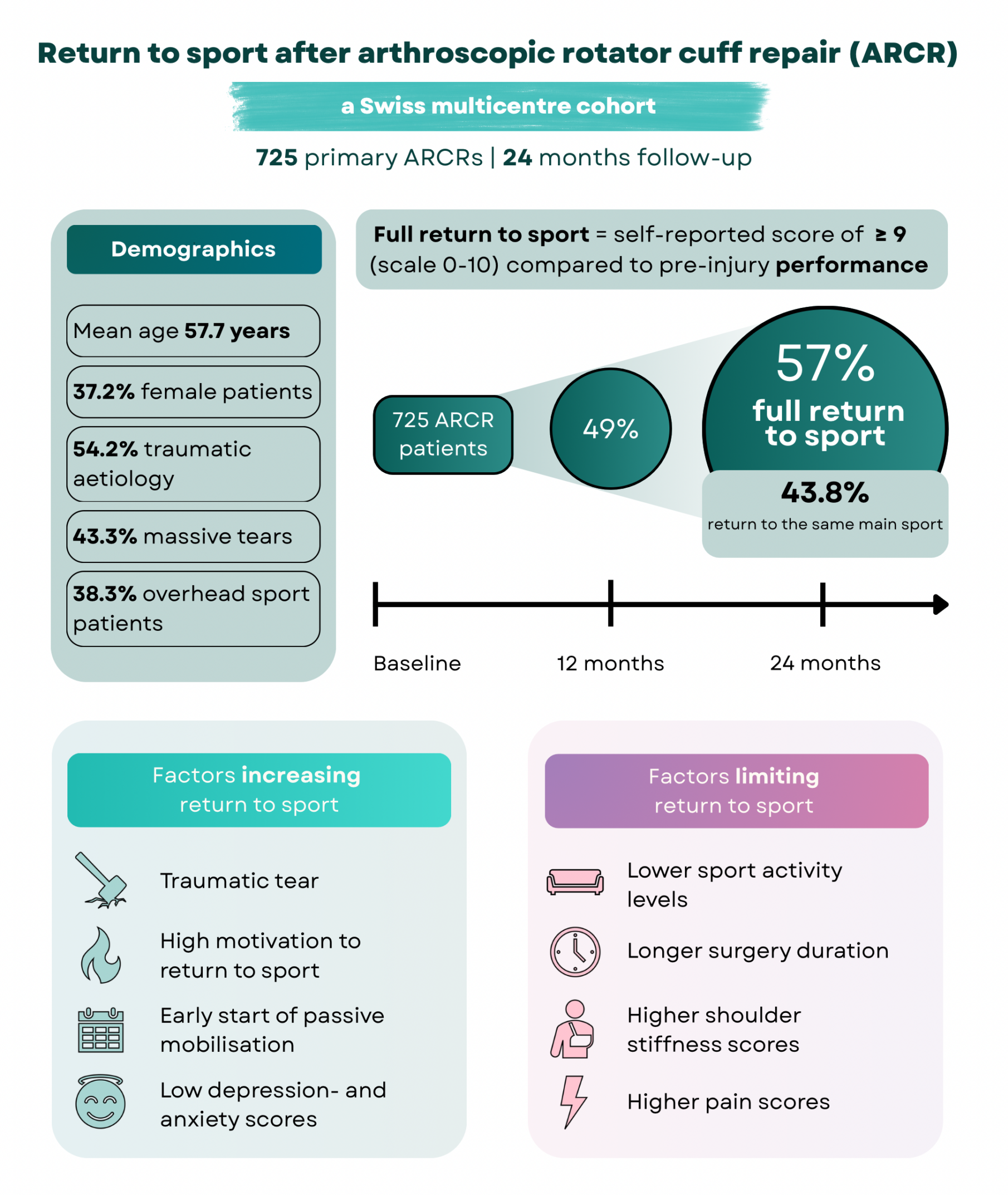
Among the 725 patients, 37.2% were female, and the mean age was 57.7 years. The severity of the RCT was classified intraoperatively as a massive tear in 43.3%. The tear was associated with a traumatic event in 54.2% of cases. The most frequently reported sports were cycling (n=231), jogging/running (n=189) and hiking/mountaineering (n=173). Of the cohort, 38.3% were classified as overhead-sport patients. The most practised overhead sports were swimming (n=114), weight training (n=65) and tennis (n=49).
At 12 months, 49.5% of patients had already reached full RTS; by 24 months, this proportion increased to 57.4%. The proportion of patients that achieved full RTS within 24 months was higher in the overhead sport group. Among patients who achieved full RTS within 24 months, 90.1% returned to at least one sport they had practised before the injury and 43.8% returned to their same main sport. In the univariable and multivariable analysis, several factors showed a significant association with full RTS (p<0.05). These included dominance of the operated side, age at surgery and traumatic injury. The time of onset of passive movements in weeks, a higher baseline level of sports activity, and psychological factors at almost all follow-up points were significantly associated with full RTS. Practising an overhead sport was not significantly associated with RTS outcome.
What are the key take-home points?
Over half of ARCR patients reach full RTS within 24 months, with traumatic injuries, early start of passive mobilisation, and higher sports activity at baseline having a more favourable prognosis. Psychological factors – particularly the motivation to RTS and depression scores had a significant impact on RTS. Participation in overhead sports had no clear influence on RTS rates.
References
- Warth RJ, Briggs KK, Dornan GJ, et al. Patient expectations before arthroscopic shoulder surgery: correlation with patients’ reasons for seeking treatment. J Shoulder Elbow Surg 2013;22(12):1676-81. doi: 10.1016/j.jse.2013.05.003 [published Online First: 454 20130711]
- Young SW, Dakic J, Stroia K, et al. Arthroscopic Shoulder Surgery in Female Professional Tennis Players: Ability and Timing to Return to Play. Clin J Sport Med 2017;27(4):357-60. doi: 10.1097/jsm.0000000000000361
- Rossi LA, Atala N, Bertona A, et al. Return to Sports After in Situ Arthroscopic Repair of Partial Rotator Cuff Tears. Arthroscopy 2019;35(1):32-37. doi: 10.1016/j.arthro.2018.07.037 [published Online First: 20181122]
- Bhatia S, Greenspoon JA, Horan MP, et al. Two-Year Outcomes After Arthroscopic Rotator Cuff Repair in Recreational Athletes Older Than 70 Years. Am J Sports Med 2015;43(7):1737-42. doi: 10.1177/0363546515577623 [published Online First: 20150401]
- Rupp MC, Chang P, Horan MP, et al. Arthroscopic rotator cuff repair in active patients younger than 45 Years: a prospective analysis with a mean 5-year follow-up. JSES Int 2024;8(4):798-805. doi: 10.1016/j.jseint.2024.03.002 [published Online First: 20240328]
- Matter M, Audigé L, Stojanov T, et al. Return to sport after arthroscopic rotator cuff repair: epidemiology and prognostic factors in a Swiss multicentre cohort. British Journal of Sports Medicine 2026;60:116-124.
Authors of the blog: Madlaina Matter, Laurent Audigé